
Finding mold in your home raises two questions right away: how serious is it, and how much will it cost to fix? The cost question is fair, and you deserve real numbers instead of a vague answer that leaves you guessing.
Mold remediation covers a wide range of prices. A small patch caught early might cost a few hundred dollars. Widespread contamination that's spread inside walls or through an HVAC system can run into the tens of thousands. The price isn't arbitrary, though. It comes down to a handful of clear factors, and once you understand them, you can estimate where your situation is likely to land.
As a family-owned restoration company serving metro Atlanta, we believe in being upfront about cost. This guide breaks down real price ranges by project size and by where the mold is in the home. It explains what drives the number up or down, and shows you how to get an estimate you can trust.
The Short Answer
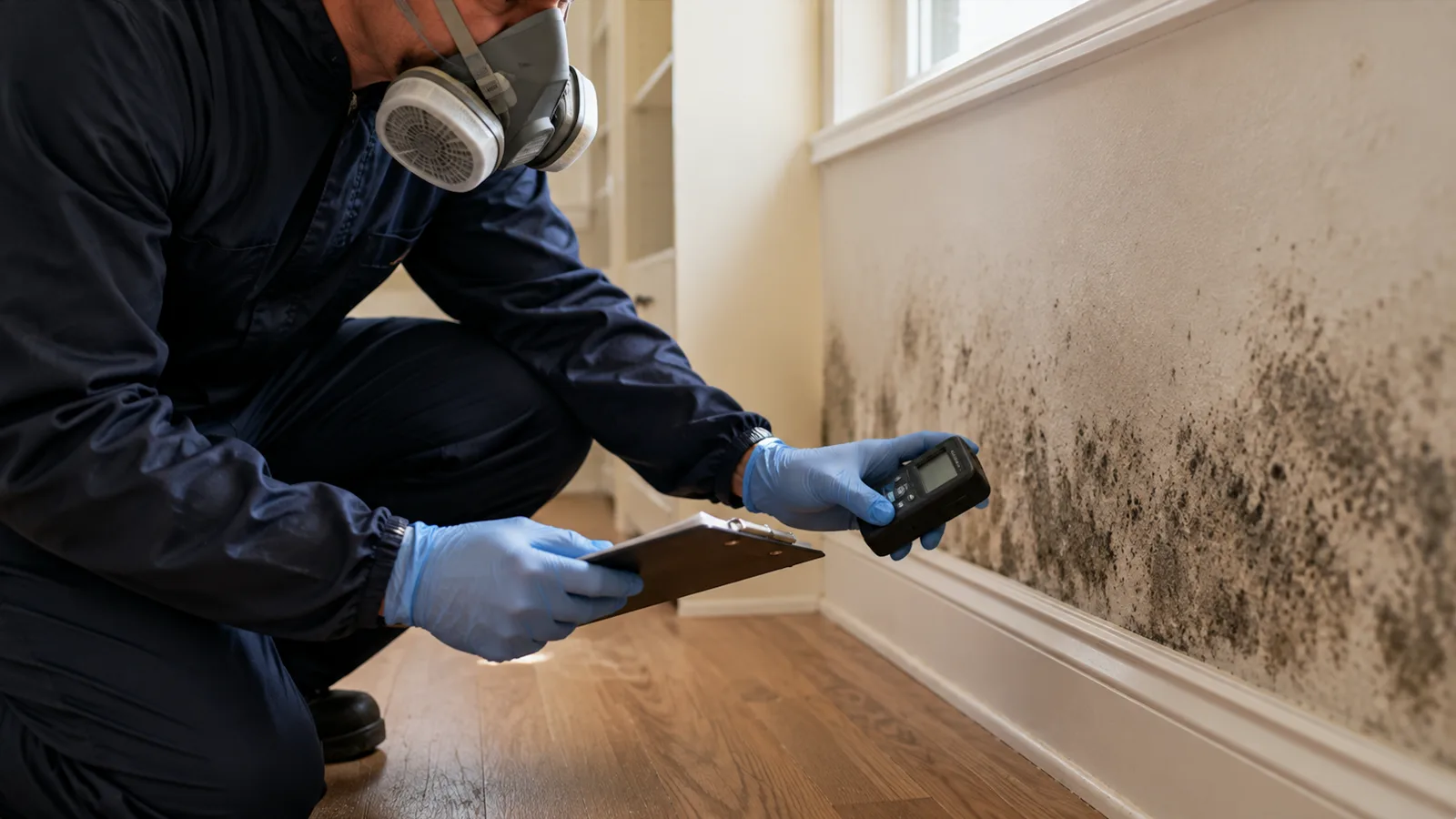
Most professional mold remediation projects fall between about $1,100 and $3,400, with a national average near $2,200. That's roughly $10 to $25 per square foot. Small spots can cost a few hundred dollars, while widespread contamination through walls or an HVAC system can reach $10,000 to $30,000 or more. The final number comes down to how much area is affected, where the mold is, and what caused it.
In This Guide
Average Mold Remediation Cost
Nationally, homeowners typically spend between $1,100 and $3,400 on professional mold remediation, with an average around $2,200. Many companies estimate on a per-square-foot basis, and for most jobs that figure lands between $10 and $25 per square foot of affected area.
The Environmental Protection Agency suggests that a mold patch smaller than about 10 square feet can often be handled by a homeowner who takes the right precautions. Once mold covers a larger area, spreads inside walls, or involves contaminated water, professional remediation is the safer choice.
The ranges below will help you narrow in on your situation. Keep in mind that these are general estimates, not a quote. Every home and every mold problem is different.
Cost by Location in the Home
Where the mold is growing has a big effect on the price. Some spots are harder to reach, harder to contain, or more likely to hide a moisture problem. Here are typical ranges for common locations:
- Bathroom: roughly $500 to $3,000, depending on whether the mold is surface-level or has spread behind tile and drywall.
- Attic: around $1,000 to $4,000, often tied to roof leaks or poor ventilation.
- Basement or crawl space: commonly $500 to $4,000, driven by moisture and how much finished space is involved.
- Drywall and walls: around $1,000 to $2,500 when affected sections have to be removed and replaced.
- HVAC and ductwork: often $3,000 to $10,000, because a contaminated system can spread spores through the whole home and takes real labor to clean.
- Whole-house contamination: $10,000 to $30,000 or more in severe cases involving multiple rooms and structural materials.
Many real projects combine several of these. A hidden roof leak, for example, can lead to mold in the attic, down through the insulation, and into the ceiling below. That's how a single moisture source spreads the cost across the home.
Cost of Mold Inspection and Testing
Before remediation begins, many homeowners start with an inspection to confirm how far the mold has spread and to find the moisture source feeding it. A professional mold inspection typically costs between $300 and $700. Adding lab testing of samples can raise that by another $100 to $300.
Testing isn't always necessary. If the mold is clearly visible and the cause is obvious, a good remediation company can often move straight to a plan without paying for lab work. Testing is most useful when mold is suspected but hidden, when you need to confirm a problem is resolved, or before a home sale. It's worth asking whether the inspection fee gets credited toward the remediation if you move forward.
Factors That Affect the Price
Beyond size and location, a few factors push a mold project toward the low or high end of these ranges:
- The size of the affected area. More square footage means more containment, more labor, and more material to remove.
- The moisture source. Mold always comes from a water problem. If the cause is an active leak or a humidity issue, fixing that source is part of the job and part of the cost.
- How deep it has spread. Surface mold on a hard surface is far cheaper than mold that's grown into drywall, insulation, or framing that has to be removed and rebuilt.
- Containment requirements. Keeping spores from spreading during removal takes sealing, negative air pressure, and filtration, which adds up on larger jobs.
- Repairs and rebuilding. When materials come out, the space has to be put back. Our restoration and reconstruction services cover that rebuild.
That's why two homes with the "same" mold problem can end up with very different bills. What's behind the visible mold matters as much as the patch you can see.
Does Insurance Cover Mold Remediation?
Sometimes, and it depends on what caused the mold. Most homeowners policies cover mold only when it grows as the result of a sudden, covered event like a burst pipe. Even then, many policies cap how much they'll pay for mold specifically. Mold that develops from a long-term leak, humidity, or neglect is usually treated as a maintenance issue and excluded.
Because the coverage rules are so specific, it's worth understanding them before you file. We cover exactly when mold is and isn't covered, along with the typical dollar caps, in our companion guide, does homeowners insurance cover mold?
When mold follows a covered water event, the cost overlaps with the broader water damage claim. If that's your situation, our guide on how much water damage restoration costs is a useful companion. We also offer direct insurance billing to keep your out-of-pocket cost as clear as possible.
Why Acting Fast Lowers the Cost
Mold is a growing problem in the most literal sense. It keeps spreading as long as moisture is present, and the more it spreads, the more it costs to remove. A small patch handled this week is far cheaper than the same problem left for a month.
Mold can start growing within 24 to 48 hours of a water event, which is why handling water damage quickly is the best mold prevention there is. If you've had a recent leak or flood, drying the area thoroughly and fast can keep a mold problem from starting at all. Our step-by-step guide on what to do immediately after water damage walks through those first critical hours.
If mold has already taken hold, catching it early still limits the spread and the price. You can learn more about our mold remediation services and how we contain and remove it safely.
How to Get an Accurate Estimate
The ranges in this guide are useful for setting expectations, but the only way to know your real cost is an on-site inspection. Mold often hides inside walls, above ceilings, and around ductwork, so a proper estimate depends on finding what a quick look can't see.
A trustworthy estimate should include:
- Identification of the moisture source causing the mold
- A clear scope of work covering containment, removal, and cleanup
- Line-item pricing you can review, rather than a single lump sum
- A plan to repair or rebuild anything that has to be removed
Be cautious of any quote that skips the moisture source. Removing mold without fixing what feeds it almost guarantees it comes back, and that turns a one-time cost into a recurring one.
Getting a Straight Answer on Your Home
At Atlanta Elite Reconstruction Services, we give homeowners honest, detailed estimates. We handle the full process, from finding the moisture source through removal and rebuilding, under one team. Our lead specialist is IICRC certified in Applied Microbial Remediation, we respond 24/7 across metro Atlanta, and we offer direct insurance billing when mold is tied to a covered claim. If you want a real number for your home, reach out for an inspection and we'll come take a look.

About the Author
Matthew Borzie is the founder of Atlanta Elite Reconstruction Services, a family-owned restoration company based in Decatur, Georgia. He is IICRC certified in Water Damage Restoration, Applied Structural Drying, and Applied Microbial Remediation.
The prices in this article are general estimates for informational purposes and are not a quote. Actual costs vary by market, home, and the specifics of the mold problem. Contact us for an assessment of your situation.